
One Health innovation network for technological solutions to prevent resistance in a resilient agricultural and food economy.
| Project form: | ZIM Innovation Network |
| Project start: | May 2026 |
| Runtime: | 1.5 years (Phase 1) |
| Network management: | Frankenförder Forschungsgesellschaft mbH (FFG) |
| Network partner: | 11 companies, 4 research institutions (DE), 2 companies, 1 research institution (A), 2 associated partners: 1 research institution (ETH), 1 association (D) |
Brief description
Resistance development affects not only bacteria (antibiotic resistance) but increasingly also fungi, viruses and parasites. These microbial adaptation processes endanger the effectiveness of vital medicines (antibiotics, antifungals, antiparasitics, antivirals) and control agents (disinfectants, pesticides, herbicides), thereby impairing health, food security and ecosystems. Causes include the overuse and misuse of active ingredients, as well as global production and environmental flows that spread resistant organisms and genes, and a lack of resilience in organisms against certain pathogens and influences.
Preventing the development of resistance is a key prerequisite for the sustainability of the global agriculture and food industry. Especially in times of crisis, regional food security takes on great importance. To ensure this while also taking the One Health approach into account, innovations are needed that offer technological solutions to address current and future challenges and that also have growth potential. To provide solutions to these challenges, the international network combines traditional and modern key technologies.
The ZIM Innovation Network RESINET pursues the goal of technology-based solutions to Resistance prevention to develop and thus the Resilience of the agricultural and food industry zu stärken. Im Sinne des One-Health-Ansatzes werden Mensch, Tier, Pflanze, Boden und Umwelt als vernetzte Systeme betrachtet.
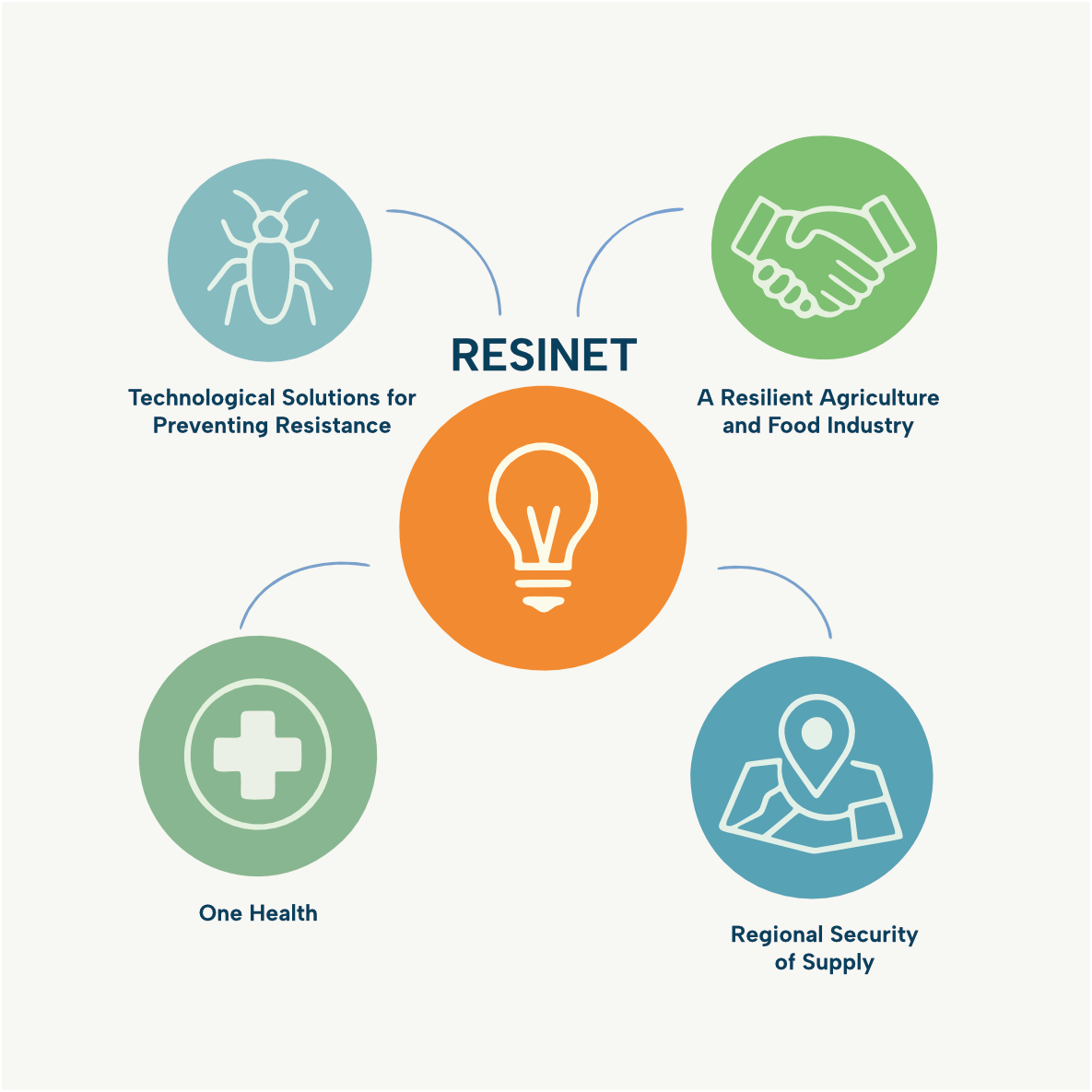
The central aim is to counteract the increasing development of resistance worldwide – through new analytical/diagnostic methods, digital technologies, ecological production methods, and interdisciplinary cooperation.
The network aims to develop products, processes, and services that help to detect, prevent, or reduce resistance early, thereby sustainably strengthening regional and global supply security.